
Welcome back to Milwaukee Metal Monthly, the column where I happily talk to creative people who use aggressive music as their canvas.
This month, we’re doing another double-album, vault-clearing dealie in terms of length. There was just too much good stuff in these conversations. This time around, however, it’s kinda fitting since one of the people I spoke to kinda-sorta did that with their latest pair of releases—more on that later.
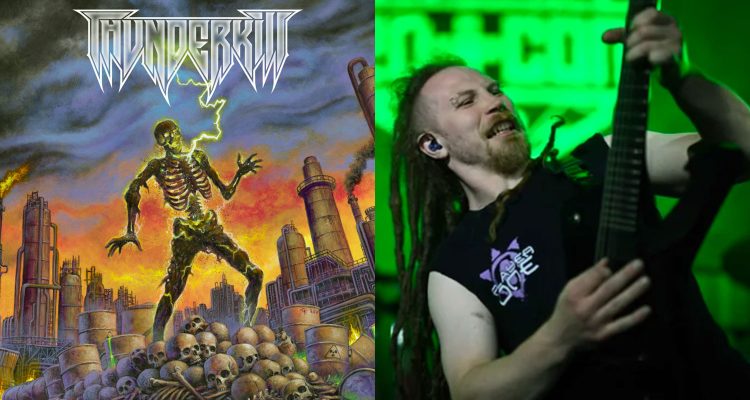
The first interview this month is with Keith D, a prolific musician and songwriter who’s released 15 albums across several different genres, including a doom metal project called Unearthed Elf and a deathgrind project called Chopping Mall (which, fun fact, was previously covered by the Record). Anyhow, I sat down with Keith D at the Hawthorne Coffee Roasters on Howell to discuss his newest endeavor, a thrash band called Thunderkill, and its just-released debut LP Global Cataclysm. (You mighta heard about it earlier this month.) Along for the ride was drummer Nick Smalkowski, who also plays with Keith D in the proggy doom metal band Arctic Sleep.
If any or all of that interests you, Keith D’s gotcha covered: “You can check out all the weird iterations of the music and different projects that we have put out on DripfeedRecords.com, which is our place to get weird and put all that weird stuff on there.”
When talking with Keith D, it’s important to (re?)calibrate your understanding of when he’s kidding and when he’s being serious. He’s got a deadpan delivery, and he also makes self-depricating asides, so it’s not always clear which is which. For example, early on I ask about his songwriting process of creating song titles first and then writing music and lyrics based on those titles—something I’d discovered after stumbling across Keith D’s appearance on the Metalheads Podcast back in 2023. “I’ll always come up with the song title first, even before writing a single note of music,” he says. “And that just kinda gives me the idea, the aesthetic, I want.” I then inquire if the titles ever change after writing music and lyrics for them. “Yeah, sometimes,” he replies. “Sometimes I will shorten a title or make it longer.” There’s a brief pause, and then he tosses out this delightful gem: “That’s a dumb answer.”
Given the above information, it may come as a surprise that the duo has decided to make a record as angry as Global Cataclysm. To be clear: Keith D has experience with channeling that emotion in his music. “I’ve expressed anger in the past, like in the Chopping Mall record, but it was more through a lens of silliness,” he says. “Even in that album, I’m taking pot shots at things like trophy hunting and overpopulation and serious things like that, but from a goofy angle.”
But with Global, it’s unabashed rage. The first lyrics you hear set the album’s tone pretty well: “Trapped in a web of regressive ideology / Overridden by the powers that be / Factories poisoning the air we breathe / Burning us alive from the inside.” The record’s also exhilarating and super-fun—as thrash should be—but it’s the fury that’s particularly notable. “After writing a coupl’a goofier records, the pendulum swings in the opposite direction to make a more serious album,” he explains. “This is actually my first time writing lyrics or songs that are outright political and talking about social issues—serious, actual problems in the world.”
And since this is Keith D’s first attempt at thrash—which also may come as a surprise, given the broad range of music he’s made—I ask why now. “It’s as good a time as any,” he offers. “The Thunderkill record is straight-ahead, dead-serious, pissed off. And let’s face it—there’s a lot to be pissed off about. There’s never a shortage of things to be pissed off about, but there’s a really good recipe of horrible shit going on. It’s like we’re living through a thrash record, basically.”
But the, let’s say, precarious state of the world isn’t the only reason why Global Cataclysm exists. The other reason is that Keith D and Smalkowski just like to try new things, and the explanation is a tag-team effort. “I’ll speak for myself: I like many different kinds of music, and many different types of metal, and I think it’s fun to dabble in whatever is fun to play,” Smalkowski says. “I really wanted to make a thrash album.” Keith D then affirms that: “Yeah, we both did.” Then Smalkowski jumps back in: “Thrash is where most of the bands I listen to operate.” And then Keith D brings it home: “What I grew up with, too, is the good ol’ Metallica and Megadeth and Testament and Nuclear Assault and stuff like that.”
Because Thunderkill is a trio, I s’pose we should talk about the band’s third member, an Argentinian vocalist who goes by the stage name Miny. When I ask about the logistics of having a vocalist from another continent, Smalkowski gives the succinct answer: “Technology makes it easy.” Keith D then expounds on that, as only he can: “I’m very much an old man when it comes to modern tech-anything, but one thing I will say that is really beautiful about the internet—there’s plenty of bad things you could say about it, of course, and it may be the dead end of western civilization as we know it—but one of the positive things, the beautiful things, about it is how it’s enabled musicians to connect with other musicians on the other side of the world and collaborate almost as if you were in the same room.”
As for how and why Miny was chosen, well—Keith D knows his own limitations. “With this project, I just didn’t feel like I was the right vocalist for it,” he admits. “Originally, I was just gonna do all the singing myself, but I didn’t think my voice was right for it. I’m not a really good screamer. I can grunt a little bit, and I can do the low, Cookie Monster growl-y stuff really well, but I wanted somebody who could really belt out a good fry scream, and I cannot do that for more than a couple seconds [before] my throat is fried.” And when Keith D discovered Miny by just “poking around the internet,” he was sold. “She was offering freelance vocal services. She is a vocal coach, as well, down there in Argentina. And I was really impressed with what I heard. Just a range of styles—everything from really pretty singing to low guttural stuff to the big fry screams. She could just really belt it out.”
View this post on Instagram
Interestingly, there was a secondary consideration about picking Miny. “Let’s face it—thrash metal is a lotta dudes,” asserts Keith D. Smalkowski quickly echoes that sentiment: “Very male-dominated.” And then Keith D comes in with another deadpan one-liner: “It’s…I don’t wanna be in print using the words ‘sausage fest.’” A round of laughs follows, and then Keith D doubles down: “But thrash is a sausage fest. It’s almost all dudes. There’s very few female players.” I reply that, unfortunately, metal’s been a boys club for five and a half decades. “Yeah,” agrees Keith D. “It’s changing, though, for the better. That’s a good thing. And having [Miny] on board with the vocals just really gave [the album] a fresh sound. And she just sounds so pissed off, too.”
Out of a combination of journalistic curiosity and a (selfish?) desire to hear some of this material live, I ask whether there’s any chance of a Thunderkill show, even with a member in another country. “Boy, would that be a lotta fun,” responds Keith D. “I wish I could, but I guess there’s the obvious logistical concerns with having to fly somebody in from another country ’n everything. So a lotta these studio projects, they end being just that. I suppose that would be the one drawback from working with people from all over the world that have their own bands. You can’t really shop it around live, I suppose. But that’s okay ’cause we’ll be moving on to something else.”
As a huge thrash fan in general, and Thunderkill’s album in specific, that was a bit disappointing to hear, even as I was more or less sure that was the case before asking. However, there’s good news buried in there: Keith D is in fact moving on to his next project. And while it’s too early to discuss specifics, he confirms it’s “one-eighty degrees from the thrash album.” That brings us back to all the genre-hopping, and another tag-team effort. “It’s just fun to try new things,” says Keith D. Then Smalkowski: “We don’t have any pressure.” Back to Keith D: “Yeah, since you’re not tied down to, like, a certain band that you have to show up for rehearsal to every week and play the same stuff. We can sorta do whatever we want. It might be a beautiful, acoustic folk record.” Smalkowski laughs, then Keith D concludes with a shrug: “It might be a buncha love songs.”
Our other interview this month is with guitarist and songwriter Patrick Gunderson, who records metal-ified covers of video game music, or VGM, under the moniker Gunderslam. (You may recall that I included his 2025 album, Wrath Beyond Creation, as one to check out in the December 2025 installment of this column.) He’s also in a VGM band called Nemesis Engine, who market themselves as “The Heaviest Band in VGM,” and it’s hard to argue otherwise.
Anyhow, Gunderson is highly knowledgeable about video games and heavy metal, and, more importantly, is a helluva nice dude who’s more than willing to expound on any topic when asked. Indeed, when I thank him for his time at the end of our 20-minute phone call, he kindly replies, “I love doing interviews, so it’s cool.”
The obvious starting point is how Gunderson got into both heavy metal and video games, and the resulting career intersection. “It starts with video games,” he says. “I grew up with an N64 as my first video game console. so that’s where it started. But then when I got into middle school, that’s when heavy metal guitar got introduced to me. And around that time, that’s when Guitar Hero was also kind of a thing, so naturally it was kind of a crossover between video games and music for me. But that’s basically where it all kinda started, at least the crossover thing.”
That leads me to ask if there was a moment or a game or a song that inspired Gunderson to get into VGM. “So, there’s a couple different instances,” he says. “Being a fan of Ocarina Of Time, for instance—that soundtrack always stood out to me, and it always resonated very well. So, as I was playing and learning [guitar]—especially in high school—the thought always kinda crossed my mind of, ‘What if this became a metal song?’ Another instance was when I started the first band I ever did, which was Slug Shell way back when. Me and the other guitar player that started it at the time, he pulled up ‘Geometry Wars’—it’s not on the record, but it’s on my YouTube Channel—and I did a cover of [‘Song Of Storms’], and that’s ’cause he brought it up. He was like, ‘Dude, this would sound really cool if this was a metal song.’ I was like, ‘Really? Well, lemme check it out.’ And it turns out it was in the same tune we were playing in, and we just started chugging along to it. Lo and behold, I was like, ‘I should start doing video game covers. This would be really cool.’
Thus, we arrive at the reason for the interview. Last month, Gunderson released two compilation albums of his past work, Gunderslam Volume 1 and Gunderslam Volume 2, that collect covers he’s done since 2014, with the first volume containing work from 2014-18, and the second containing work from 2018-26. When I ask if the goal is a kind of vault-clearing, Gunderson confirms this. “It is the goal,” he says. “The first song on the first record is the first one I ever did—‘Song Of Storms’—that goes all the way back to 2014. I spiced it up and beefed it up from the original.” Gunderson then discusses updating some of the songs, and the accompanying evolution of his solo work. “I’ve kinda gone over them and given them some facelifts here ’n there. Some of them I’ve just kinda left as-is. Some of them I needed to desperately fix some problems with the mixes. You’ll hear the quality change over the records, especially on the first volume. The second one, though, is when you can kinda hear where I started getting a little bit more consistent because this is all my solo project. This is me getting into not just video game music and being a solo artist, but also home recording and experimenting.”
If you look through Gunderson’s catalog, you might notice his song selections suggest that he doesn’t opt for the obvious choice. As such, I ask him how he picks songs. “It’s a mix between songs I wanted to do, and some of the songs on the records—especially that first one—were part of when I was part of a group called Pixel Mixers.” (Gunderson later clarifies via email that it’s “group” as in “collective,” not “group” as in “band,” and that collective of VGM musicians collaborates and puts out albums.) “There were records that we did, but there was only a certain amount of songs I was allowed to pick from, or they got claimed by another artist. So I got stuck with whatever I stuck with. So, some of the songs weren’t my choice, some were. It just depended if I was part of one of those records, or if I was just doing my own thing. Like, ‘Potion Shop,’ for example, from Zelda was my choice, but ‘Freya’s Theme’ from Final Fantasy IX was not my choice, and I just rolled with it.”
And then, of course, there’s the live aspect of VGM for Gunderson. To wit, he’s played a coupl’a notable shows in the last 12 months that we discuss. The first is that he played Summerfest last year, and in fact he played it twice on the same day: once as Gunderslam, and once with his non-VGM band H1Z1. “We played the Tiki Stage,” he remembers. “It’s one of the smaller side stages, and they are very, very awesome in letting DIY and local bands play the event that started out as a DIY and local-band festival. So I did a double set in hundred-degree weather with the sun directly on us. That was something else, but I certainly survived.” The most interesting tidbit, though, is this: “There’s definitely never been a video game cover band that’s played that festival in any capacity. And if they have, I have no idea, and someone can correct me,” he says with a chuckle. “But I’ll take the crown on being the first VGM act that’s ever played Summerfest.”
The other performance discussed was Gunderson playing the main stage at this year’s Music And Gaming Festival, something he calls “fantastic” and “definitely a bucket-list item.” If you’re wondering how that came about, the answer is effective networking. “I have been going to the Music And Gaming Festival every year since 2018,” he says. “And just one of the inspirations to start this project is that there’s a lotta solo YouTube VGM guys out there, but I saw a Viking Guitar performance from 2014 and I was like, ‘I want to play that stage.’ So I started going to the event, meeting people there, playing, networking. Even when I’m not performing, that is one of my favorite things to do.” He then highlights one person from the festival in particular. “One of the big people that helped me out to get onto the main stage was someone who got me on the smaller stage in 2023, and that’s Chris Ryberg with his XP stage now. So shoutout to him for listening to me and saying, ‘Hey, we should have some spotlight and have a second stage that can host bands that are used to club shows that have this underground vibe.’”
Speaking of Gunderson’s live performances, while I was doing research for the interview, I came across a clip of Gunderslam playing last year’s Midwest Gaming Classic where Gunderson used his platform to make a political statement that includes “Black Lives Matter,” and “Free Palestine.” Naturally, I had to know whether Gunderson thought it was important for artists to do so if given the chance. His candor here is admirable, which is why I included the entire response.
“I mean, music has always been political, as I’ve learned,” he says. “I think it’s extremely important [to make a statement], especially now. If you’re paying attention, you’re noticing how much of a farce this administration has been. It’s unfathomably unbelievable because I don’t think at any point in American history it’s been this fucked up. I’m sure someone could probably argue something was worse because I wasn’t alive before the 1990s, but I think it’s extremely important. We talked about it as a band, and part of the reason we did that—have me saying that stuff—is because we’re an instrumental band. There’s no lyrics to be able to talk about that kinda stuff or anything like that, and I don’t want people thinking that they can have their shitty views and come to my show. They need to know that they’re not welcome. And I want to make sure our people are welcome, ya know? So that stuff’s super-important to us. And in the VGM scene there’s every shade of the rainbow. We have trans and queer people at our shows, and we absolutely welcome ’em.”
As for Nemesis Engine’s future plans, there are a coupl’a things coming up. They played Minnesota’s Video Games and Music Convention, or VGM CON, in Minneapolis on April 17. Gunderson mentions that they’re working on a four-song demo that they’ll be handing out while they’re there. As for new music, first up is the band’s take on the Magna Centipede theme from Mega Man X2. Gunderson guesstimates its release to be early May. (I’m pretty excited about that because the first three entries in the MMX series have the best music in the entire Mega Man franchise.) And then there’s an upcoming full-length of original material. “This’ll be fully brand new,” he states. “It’s never been released. Some of these songs have been performed live, and we’re performing two new songs at VGMCON. And we’re still working on getting the Nemesis Engine Spotify and all the socials and Bandcamp all that stuff up, ‘cause, ya know, that comes in stride.”
Towards the end of the interview, Gunderson says something that has some finality to it. “[The two volumes are] gonna be some of the last stuff I put out as Gunderslam,” he says. “There is an original EP I have in the works. So there will be just a little bit more Gunderslam coming out, but all the eggs are pretty much in the Nemesis Engine basket at this point.” That sounded like retiring the Gunderslam name, so I ask if it is. “It is and it isn’t. [The band] talked about it. Like, if we come up with an arrangement that doesn’t really fit—’cause I’m still doing most of the arrangements for these songs—so if there’s something that kinda comes up and doesn’t fit our vibe, I might throw it up on my Spotify and call it a day there. At least we’re not just letting a song fizzle out or something, ya know? Which is kinda cool that, like, it’s two acts but not at the same time. The band is Nemesis Engine, the solo project is Gunderslam, and it’s nice that I can retain my own entity, and we have our entity as a band.”
Want more Milwaukee Record? Subscribe to our free weekly newsletter and/or support us on Patreon.
RELATED ARTICLES
• Milwaukee Metal Monthly: Going into battle (and fending off shrapnel) with WMSE’s metal DJs
• Milwaukee Metal Monthly: Getting to know metal producer (and guitar teacher) Hayden Crownover
• Milwaukee Metal Monthly: Rage-baiting with Smooth Man Records, getting noisy with BxBxB
•Milwaukee Metal Monthly: Shadows Taller Than Souls, plus recent releases from 11 more MKE bands
• Milwaukee Metal Monthly: Behind the camera with Aaron Miller, in the bowl with Jeff Gozdowiak
• Milwaukee Metal Monthly: Psychic Shiv talks ‘Wearing Black,’ Imprecation Of Love talks black metal