Welcome back to Milwaukee Metal Monthly, the aggressively alliterative column where I discuss our city’s metal scene. The two interviewees this month have been on my list of potentials since September while I worked on the initial installment of MMM. The twist here, however, is that I did not speak to any bands this time around, so I suppose the theme is “Behind The Scenes.” Let’s peek behind the curtain, shall we?
First up is my phone conversation with a concert filmer and documentarian named Aaron Miller. I first came across his work while researching sublet and Krooked prior to those respective interviews, and Miller’s photography of the latter was directly referenced in the resulting column. He’s been doing this for about a year and a half, having “always loved doing photo and video.” Initially, though, he wasn’t into photographing or filming concerts, but he “was big into watching live videos from local shows.” He adds some background: “When I moved back to Milwaukee—I was living in Louisville for a little bit—I kinda noticed nobody was really [filming shows], so I decided, ‘Hey, I’ll give it a shot and start recording shows and see how it goes.’ That’s kinda how it started out.”
Like most concert attendees, Miller’s early recordings were done using his cellphone; only recently has he acquired better equipment. “Over this summer I bought a, I guess you could say, professional camera,” he explains. “Like a DSLR-type deal. So I’ve been rockin’ that. And over the last year I tried to upgrade my audio. I was using a zoom recorder to record the room, and then mixing that so it’s a little better audio. I’m slowly improving the setup, and I think I’m in a good spot right now.”
The resulting improvement and evolution of Miller’s work is obvious. Take, for example, one of his early videos, a full set from Jagged at Falcon Bowl from July 2024, which has a Kevin Smith-esque flavor—which is to say: kinda static and single-angle from the back of the room.
Certainly, there’s nothing wrong with that—it’s still concert footage of what looks like a super-fun hardcore show, after all—but, unfortunately, it lives in the shadow of his later, more-skilled work of, say, the in-the-trenches feel of stuff like an All Life Gone show from September 2025 at JJ’s Bar and Grill, or the gonzo-style documentary feel of the band and the pit at a Necron 9 show at Cactus Club back in April 2025, complete with zoom-ins and -outs.
As for the latter—filming the pit itself, in addition to the band—people outside of the scene might not understand the importance of the pit to the show itself, but Miller sure does. “Yeah, [the pit] is something that people like to see,” he says. “Kids like seeing their friends go crazy in the pit and having fun. Nice thing for people to look back on.”
And while being a documentarian of a scene is a valid reason in itself, a seemingly more important one for Miller is exposure for new bands. “[My videos] are a good resource for bands to find each other to play more shows, and people finding new bands to listen to,” he says. “Especially for bands that don’t have music released, I find it’s a resource for finding out what a band sounds like. If [new bands] don’t have any music released, a live video on YouTube is a good place to start. And I’m happy to be that resource, as well as creating an archive of the scene and the community—kind of a snapshot of what the scene is at this point in history.”
That archive is updated regularly on Miller’s YouTube channel, the description of which reads: “Documenting mostly Hardcore/Metal live shows around the Milwaukee & Madison, Wisconsin area (and sometimes Chicago). NEW SET EVERYDAY!!! (almost).” If, like me, you’re wondering how one person can publish at that rate, it’s because Miller smartly paces himself. “Normally it doesn’t take me too long to edit,” he says. “Might take me an hour, hour and a half to edit the set and get it posted. I think limiting myself to posting one a day has helped me manage my time more, as opposed to, ‘I’m gonna try to knock out these four sets from this show and post ’em all today.’ I feel like that would take me several hours. If I just try to knock out one a day, it’s really only an hour or two outta my day. Plus, I wanna keep [the YouTube channel] fresh. I wanna get new stuff out regularly.”
If that sounds like DIY ethos, well, that’s because it pretty much is. “I love DIY stuff,” Miller says. “I love keepin’ it simple. Whatever I can do myself, I do myself.”
Which of course is probably why he favors, but doesn’t limit himself to, hardcore shows. “Most of the shows I go to have been hardcore shows,” he says. “But I like going out to death metal shows, a couple emo shows at MKEUltra. [In September] I was at snag., Courtesy, and Okay Omen. That was kind of an emo show. So, kind of a variety. And I’ll also show up to grindcore shows, powerviolence, stuff like that. The sublet, Victims of Fire, Mind Harvester show at MKEUltra—I was at that show. So, really, just kinda whatever I’m into. But, really, hardcore has been the majority of what I’ve been doing.”
As for potentially building outward and/or upward, it seems that Miller would rather just forge ahead on his current (DIY) path. “I haven’t really thought about the future very much in terms of [building a brand],” he admits. “I just wanna keep doin’ what I’m doin’ and stay busy, and get out to as many shows as I can. Keep the archive alive, y’know?”
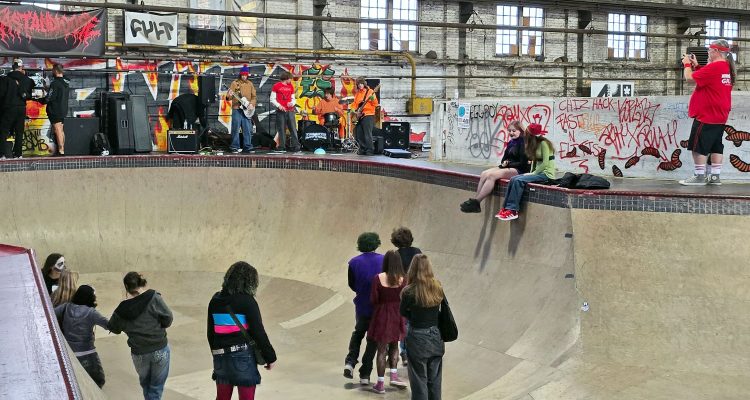
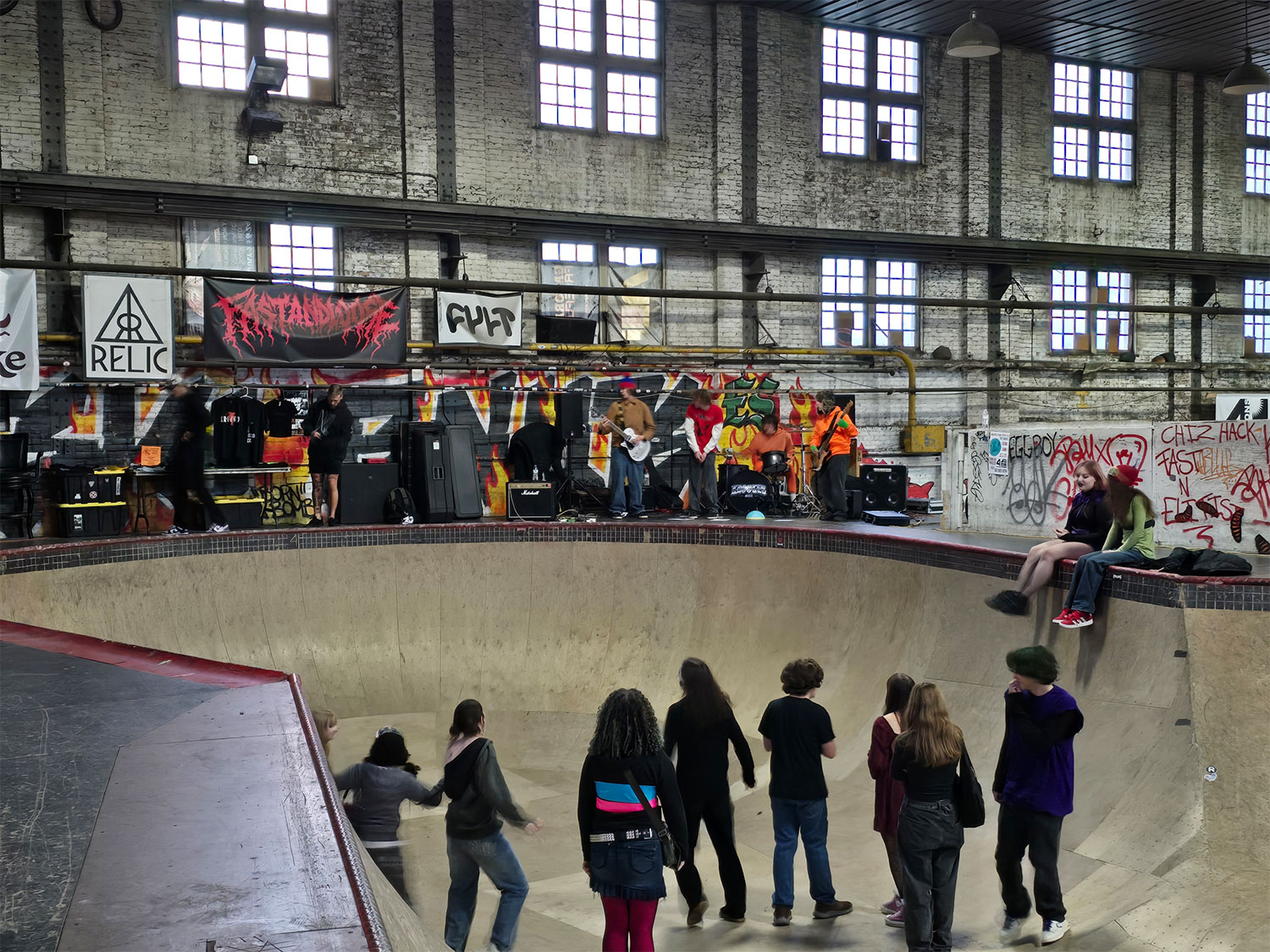
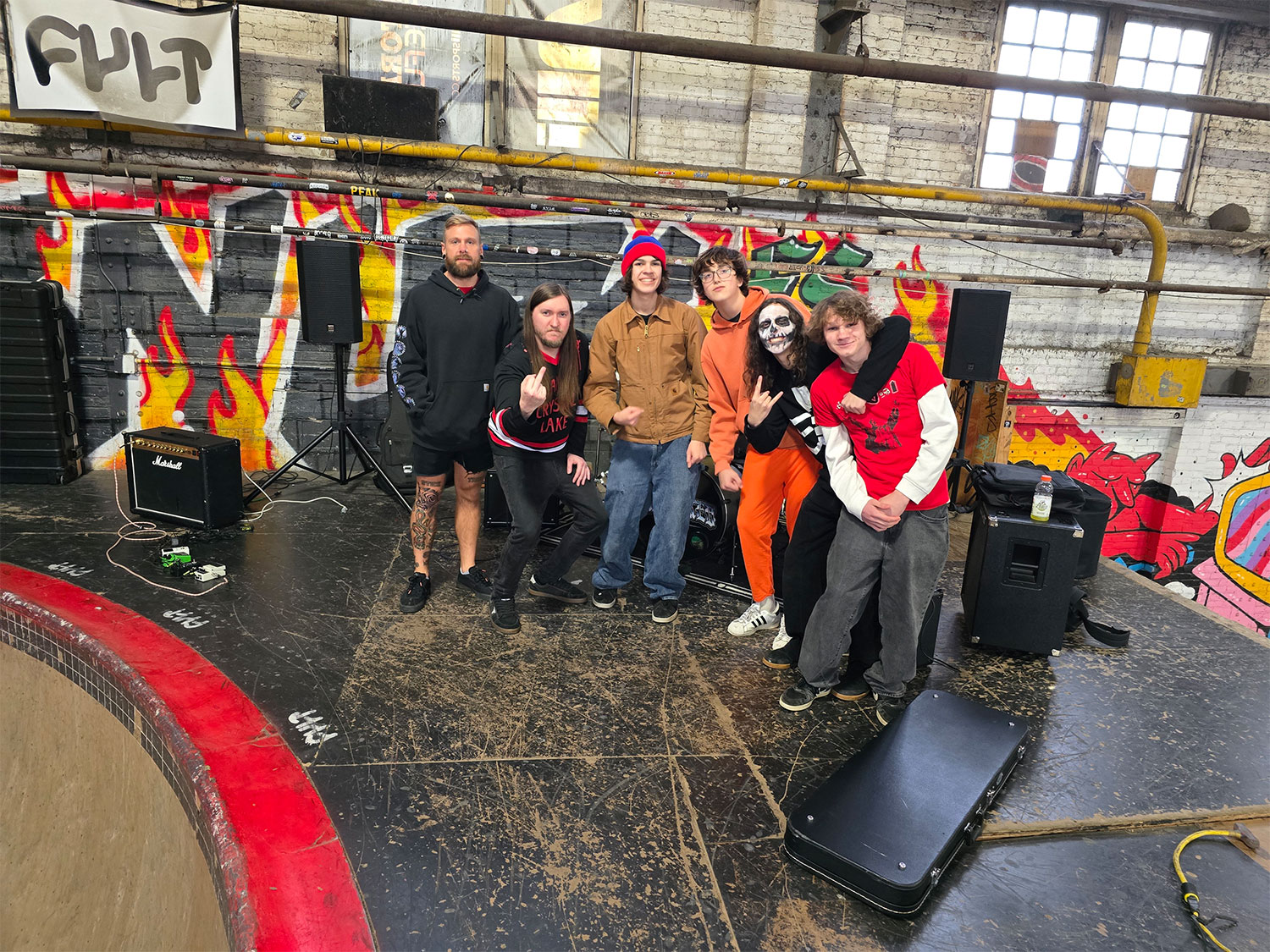
My other interview this month was with Four Seasons Skate Park owner Jeff Gozdowiak, who, like Miller, is also motivated by keeping something alive—in this case, the skate and live music scenes. In between occasional swigs of Mountain Dew, he discussed Four Seasons being a makeshift concert venue—which he’d eventually like to “Cadillac-out” and “have it be a little more official, per se” with lighting and a stage—for small and emerging hardcore and metal bands (the first bowl show of which was covered by this publication, bee tee dubs), as well as what motivates him.
For Gozdowiak, now 51, skating and music are intertwined, making them part of the same discussion, and have been for most, if not all, of his life. “Much like skating, shows were therapeutic in a way,” he says. “Go bounce around with 200 people in a room for an hour and a half, and leave sweaty as hell and tired but feelin’ good. Music was just as important to me as skateboarding growin’ up. The time when I wasn’t skating, I had headphones on and listened to shit I liked.”
Gozdowiak’s deep love for music and shows allows for an impressive collection of yesteryear anecdotes. To wit, he’s been around the scene so long that he can effortlessly throw out amusing, slice-of-life gems like: “The Unicorn, for example—Sunday they’d have a matinee show in the afternoon and a drinkin’ show at night. And if you were lucky to be able to hide out long enough, you got to see two shows in a day.”
That heartfelt, teenage wonderment about (live) music is a recurring theme over the course of a half hour. Among Gozdowiak’s first concert experiences was when his mother took him to see Styx when he was in fourth grade. But a defining moment in his taste—and possibly his lifestyle—came later. “D.R.I. was my first real punk band that I got to see,” he recalls. “I saw ’em in Philadelphia with Dr. Know and The Exploited in ’87. That was life-changing for me.”
In what sounds like the final scene to a saccharine biopic, life came full circle when D.R.I. played Four Seasons this past May during their spring tour. Interestingly, the story of how one of the pioneers of crossover thrash came to play a skate park in Milwaukee is shorter and more obvious than it’d seem. The band—whose full name is Dirty Rotten Imbeciles—is signed to the Milwaukee-based Beer City Records, so BCR inquired about D.R.I. playing at Four Seasons and whether it was logistically possible. Gozdowiak said it was, and then the band’s guitarist Spike Cassidy came to Milwaukee to check out the space and agreed.
“It worked out really good,” Gozdowiak says. “It was fun and a good mix of people. Middle school kids out there that I’d give skate lessons to were havin’ a blast.”
And to say D.R.I.’s show at Four Seasons was something special for him is an understatement: “To get to see them [back then], and then eventually [they] play in the place that I own was pretty freakin’ cool.”
To be clear: Four Seasons isn’t a venue for hardcore and metal bands exclusively. While Gozdowiak concedes that it tends to attract “heavier stuff,” he’s willing to let any act play that wants to. “I’ll book anybody,” he says. “It doesn’t matter what genre. I don’t know if limiting stuff with music is ever any good. We’ll book a three-piece folk-guitar group sometime, I’m sure. If they wanna play here, whatever. A lotta times it’s just, ‘If you wanna do it, let’s do it’ because I might be surprised to find out this band’s pretty fuckin’ cool.” (Side note: if your band is interested in playing Four Seasons, Gozdowiak advises you to send an inquiry via their Instagram account.)
And that openness is rooted—plainly, nakedly—in altruism. “I’m simple,” Gozdowiak says earnestly. “I just want [Four Seasons] to be affordable for kids, most importantly. And for adults, too, I know people are gonna come in and buy some drinks and snacks, so I’ll make a few bucks there. I’ll make a few bucks off the door. But at the end of the day, I want bands to succeed and to want to come back because they had a good experience and they got to make some decent money on their merch. You got some T-shirts on people that may not have been able to get ’em otherwise, and got kids to go, ‘Oh, that band was really fuckin’ rad. I’ll go see them again.’”
So it makes sense that Gozdowiak sees himself as a mentor of sorts, and, by extension, sees Four Seasons as a stepping stone. “My favorite thing to do here is teach lessons, and watchin’ people get better and progress is more gratifying than anything I’ve personally ever done on a skateboard,” he beams. “It’s always cool seein’ people get better and reach goals. And with the music thing—hopefully some of the bands that are playing here are able to get the bigger room at The Rave one day, and be able to do a tour where they actually make some money.”
He then shares a half-joking fantasy with a smirk: “But I always keep hopin’ that no matter who plays, one day they’re like, ‘Man, when we were first gettin’ started we played at this skate park.’ And then one day they come back and they’re like, ‘Hey, we’re rich, here’s some bucks for gettin’ us started.’”
October’s Exit
That sense of fellowship is perhaps what best defines Four Seasons. Gozdowiak uses the word “community” in reference to skating and music several times during our chat, emerging as a foundational principle. For example, here he is discussing the importance of acquiring show merch in a pre-internet world: “[Back then], you weren’t getting that shirt unless you went to the show. So when you saw somebody with that shirt, and you were at that show, you’re like, ‘Oh, I was there, too.’ They didn’t just go to a store and pick it up. So you had this community of people who like the same stuff and have fun in the same way.”
Maybe being part of a continuum, then, explains, at least in part, how Four Seasons Skate Park has survived for a quarter-century. As Gozdowiak and I spoke, customers came and went, and he was on a first-name basis with all of them. He was able to effortlessly weave in and out of small talk with everybody, going as far as noticing and then asking about a new tattoo on someone’s arm. In other words, he’s a genuinely decent person who radiates the shirt-off-your-back kindness that can inspire optimism in even the blackest-hearted of cynics.
“I’m not gonna be able to [run a skate park] forever,” he concludes, “but hopefully by helpin’ people out, the next dudes that take this over will do the same thing—give people a chance to do cool stuff.”
October’s Exit
Want more Milwaukee Record? Subscribe to our free weekly newsletter and/or support us on Patreon.
RELATED ARTICLES
• Milwaukee Metal Monthly: Psychic Shiv talks ‘Wearing Black,’ Imprecation Of Love talks black metal