
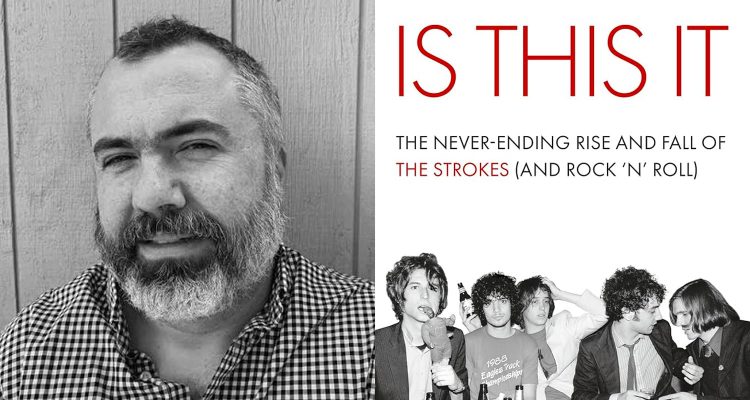
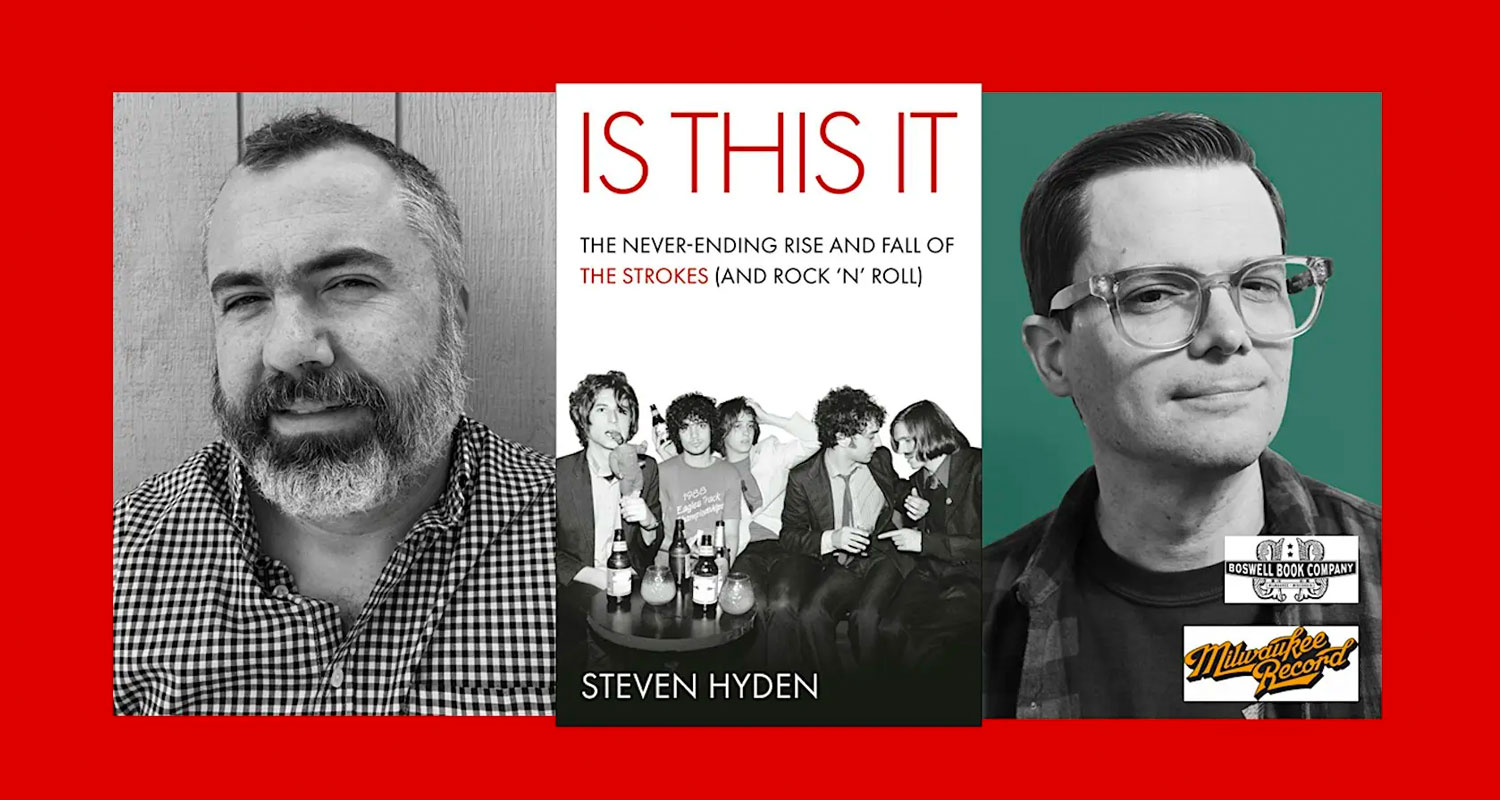
On Thursday, October 15, music critic, author, and podcast host Steven Hyden will stop by Boswell Book Company to chat about his new book, Is This It: The Never-Ending Rise And Fall Of The Strokes (And Rock ‘n’ Roll). He’ll be joined in conversation by Milwaukee Record‘s Matt Wild. (That’s me.) The 6:30 p.m. event is free to attend, though spots are limited. Reserve your spot NOW.
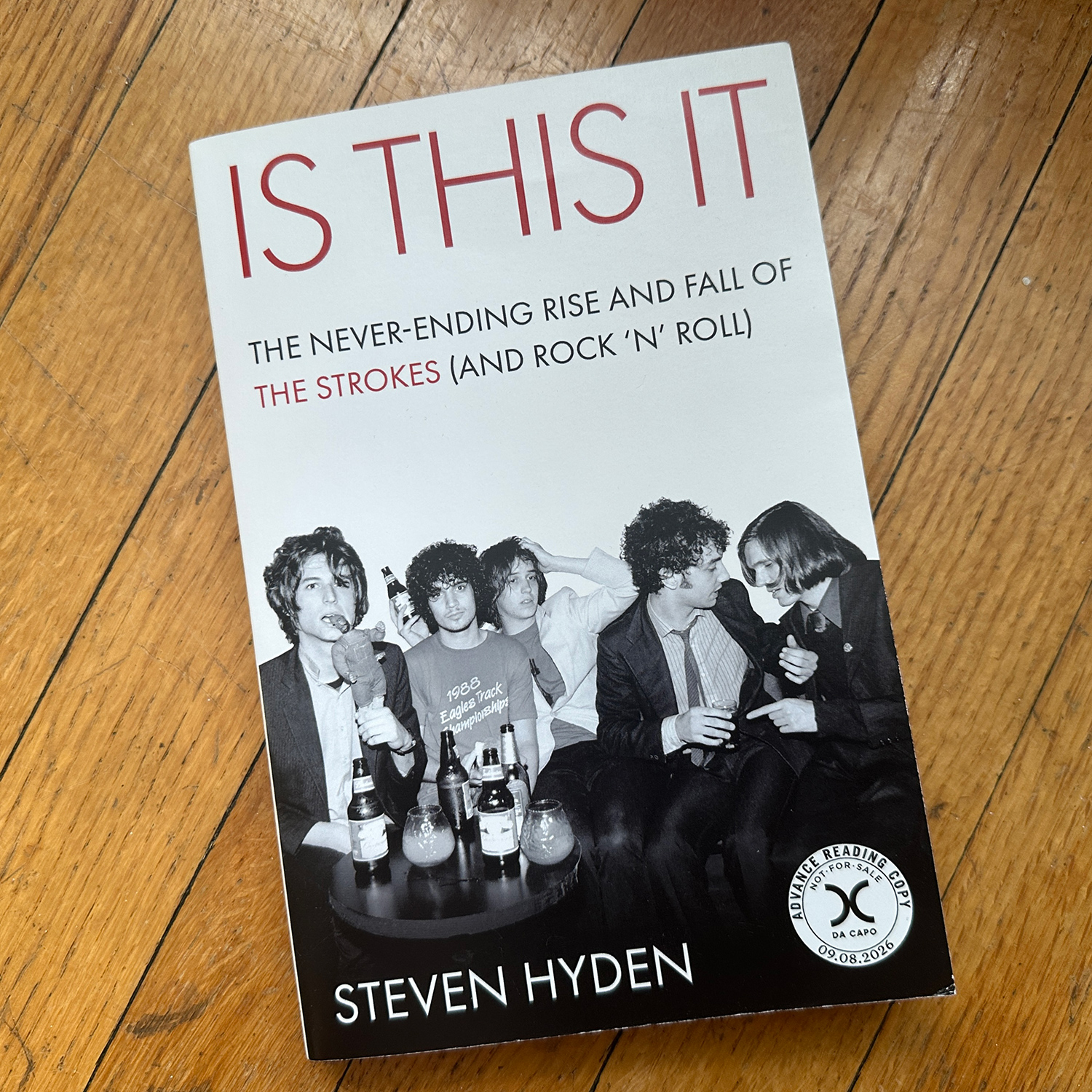
Hyden’s name should be instantly familiar to students of Milwaukee media of the late-’00s and early-’10s. The Appleton native was the editor of A.V. Club Milwaukee—a regional section of the national A.V. Club, both of which were packaged with print copies of The Onion—until 2011. (Future Milwaukee Record co-founder Matt Wild—me again—was his successor.) Hyden’s national career took off after A.V. Club Milwaukee, and would soon include staff positions at Grantland and Uproxx, as well as contributions to Pitchfork, Rolling Stone, and more. Hyden departed Milwaukee in 2014 and relocated to Minneapolis.
Beginning in 2016, Hyden added “prolific author” and “multimedia mogul” to his resume. In addition to the new (and fantastic) Strokes book, he has written incisive and accessible tomes on the decline of classic rock (Twilight Of The Gods), Radiohead (This Isn’t Happening), Pearl Jam (Long Road), and Bruce Springsteen (There Was Nothing You Could Do). In the podcast realm, he reviews new music and hashes out trends with co-host Ian Cohen every Friday for the weekly Amazon Music-sponsored Indiecast. Hyden’s Substack, Evil Speakers, is currently one of the platform’s most popular music newsletters.
Ahead of the October 15 Boswell event, Milwaukee Record spoke to Hyden over the phone—mostly about Milwaukee, but also the current state of the publishing industry, and about the need to adapt in an ever-changing media landscape. (This conversation has been edited for length.)
Milwaukee Record: You and I were both at The Strokes show at American Family Insurance Amphitheater in July. Was that your first time back in Milwaukee in a minute?
Steven Hyden: I’m back there every now and then because I have family that live there. So usually when I’m there I go around the holidays. But that was the first time I had been at the amphitheater in a long time, and maybe the first time since it’s been American Family Insurance Amphitheater. I don’t know how long that’s been the case, but I’m used to the Marcus Amphitheater. All the stadiums and amphitheaters have different names now!
I love going back to Milwaukee, and I always feel nostalgic when I do. It’ll be fun to be there next week because this is a great time to be in Milwaukee, in the fall. And hopefully the Brewers will still be in the playoffs at that point, so that’s really exciting. The last time I was there I was driving through Bay View where I used to live, and I was going past bars that I used to hang out in, feeling pangs of nostalgia ripple through me.
MR: It’s a very nostalgic town. Even if you’ve lived here for only a couple of years, there’s something about it.
SH: For sure. It’s funny, because in a lot of ways Milwaukee is different than when I lived there. I haven’t lived there for 12 years. Like, the arena where the Bucks play, I’ve never been in that place. It hadn’t been built. But then going to some of the old places that I used to frequent, a lot of that stuff is the same, which is very comforting to see. It’s a great town.
There are definitely things about it that I miss, and that I didn’t appreciate when I lived there. If you live in Milwaukee, you really ought to appreciate how close it is to so many things, how you can drive to so many different towns very easily. Where I live now doesn’t seem that far in many ways, but once you get past the Mississippi River, things get way more spread out. It’s weird to think about Minneapolis being in the West, but it is the beginning of the West in a lot of ways. Where I live now, you have to drive like four or five hours just to get to another major city, and it’s a real pain in the ass to do road trips from there. That’s one thing I loved to do when I lived in Milwaukee: just go to Nashville, you know, or go to Louisville or wherever. You could do that in a day, and you can’t do that where I live now. I miss that.
MR: It does seem there are people here who really utilize that closeness to places like Chicago. And then there are other people, myself included, who don’t utilize it enough.
SH: I didn’t appreciate that when I lived there. So I’m pleading with people to appreciate that!
I just love the neighborhoods in Milwaukee. For for a city that’s relatively small, there are distinct areas of town that when you’re there, you know you’re there. I sometimes miss covering a local community, which I haven’t done since I left. You know, where you’re following local bands and you’re going to local restaurants and you know a lot of the people in the community.
MR: You were the editor of the Milwaukee A.V. Club for a few years before you moved on to bigger things. Do you ever have moments in the night where you wake up in a cold sweat wondering, oh God, are the Summerfest attendance numbers going to be released tomorrow?
SH: [laughs] I think it’s faded by now, but I definitely have memories of those cyclical things that you would have to do and try to make people happy. I remember feeling like it was a thankless job a lot of times, covering the local community, because they just took it for granted that you would be there and that you would always be there to say really flattering things about whatever it was they were doing. And if you didn’t do that, then you were circumspect. It’s great that Milwaukee is a small town, but it would be inconvenient sometimes for someone like me who had pretensions to be a music critic. I wanted to be this person who was objective and who would write how I really felt about what was going on.
But truth be told, there were a lot of bands that I loved from that time. The Goodnight Loving, Call Me Lightning, The Trusty Knife, things like that. I saw something recently on Milwaukee Record where Tyler was writing about The Championship. He quoted me in there, and I was really excited to see that. I was like, “Oh! The Championship! I haven’t thought about them in a long time. That’s a great band!” The specificity of a local scene is something that I really put a lot of value in, and it’s not something I’ve really been able to be a part of since then. I live in the Twin Cities, but I’m on an island, really. I’m in the suburbs, I’m a parent, and I’m not really writing about stuff in Minneapolis. That feeling of walking into a bar and knowing a lot of the people in there is something I miss. I haven’t had that experience since I’ve lived here.
MR: You’ve always been good about including Milwaukee, Madison, and Midwest bands in your coverage over the years. I think you and Ian recently talked about the new Graham Hunt album on your Indiecast podcast.
SH: Yeah, Slow Pulp from Madison, too. I always like to wave the flag for that. I think I still have that feeling I had when I was a kid, that you never saw Wisconsin get talked about in the media. Or if you did, it was always putting it down. I feel like it’s my responsibility to counteract that as much as I can. But also, there’s just a lot of good stuff in Wisconsin that’s worth talking about. I always have loyalty to the scrappy Midwest band playing in a bar and trying to make their way. That’s always going to be something I cheer for.
MR: Your career trajectory from writing for a hyper-local thing like A.V. Club Milwaukee to what you’re up to now—talking and writing about national music, writing books about major artists—is impressive.
SH: I appreciate that. I consider myself to be lucky in terms of the timing that I had, as far as being able to come up first in local newspapers in my 20s, and then alt-weeklies in my 30s. The fact that The Onion had a local edition in Milwaukee…it’s hard to explain to people what that even meant, right? But I think it was a huge deal, and I would venture to say that maybe Milwaukee Record wouldn’t exist if not for that.
MR: Oh, absolutely. I mean, it probably wouldn’t exist if it wasn’t for you. I took over for you, and you practically gift-wrapped me that job.
SH: For a little while, but then it went away! It was a gift with an expiration! [laughs] You took over for me because you were clearly the best person for the job. There were not a lot of other options that were even close to how qualified you were, so it was just a natural fit.
MR: And now you’ve been rolling with the punches in the media landscape and finding success on Substack. I think you’ve mentioned you’re one of the top music Substacks out there right now?
SH: Yeah, I just checked. I’m like number two. I just passed Jeff Tweedy!
I just noticed that Evil Speakers is now the no. 2 top bestseller in the music category, finally passing my hero Jeff Tweedy. He still made Yankee Hotel Foxtrot so he’s better than me overall. But on this count, I will declare victory. https://t.co/BVnuHjNt6B
— Steven Hyden (@Steven_Hyden) October 7, 2026
I think for me in my career, the difference has been adaptability. I’ve worked in a lot of different forms of media over the last 25 years. I got started at daily newspaper in my hometown. Then I moved to Milwaukee and worked at an alt-weekly. Then I moved into websites. Then I started writing books. Now I’m doing podcasts and Substacks. I think the key to surviving in media is to find a balance where you are who you are, and people know what your identity is, but at the same time you’re fluid enough that you can move into these different areas and be yourself.
I think I’m fortunate in that I’m always going to think of myself as a writer first. But I like doing podcasts and I like doing Substacks. I’m not rigid in that I have to do just this one thing. I feel like I can express myself and do what I do in a lot of different formats and have it feel like it’s natural and it has some integrity to it.
With writing books, we’re in an interesting moment because the publishing industry is in a real state of flux in terms of where the audience is at. In the time that I’ve been writing books, which is the last 10 years, this is the most challenging time to sell books or to get people to even read books. There’s so much conditioning going on right now in terms of steering people away from reading at all, and getting them to watch video or listen to a podcast instead. It’s challenging online, but I think it’s even more challenging with books. I love writing books. It’s probably my favorite thing that I do. But it’s also the thing that I feel has the highest barrier of entry for people, where they’re willing to even pay for a book and then commit the time that it takes to read one.
Especially with the books that I write, it’s even more challenging. I’m not writing the kinds of books that naturally attract readers. But having said that, I think I’m still pretty fortunate in the audience that I do have, and this book has been reviewed by some pretty big places, which has been nice. Like you said, all you can do is just roll with the punches and keep doing what you’re doing.
Steven Hyden will discuss Is This It at Boswell Book Company on Thursday, October 15, beginning at 6:30 p.m. RSVP for free HERE.
Want more Milwaukee Record? Subscribe to our free weekly newsletter and/or support us on Patreon.
RELATED ARTICLES
• Steven Hyden will discuss his new Strokes book with Matt Wild at Boswell Book Company in October