
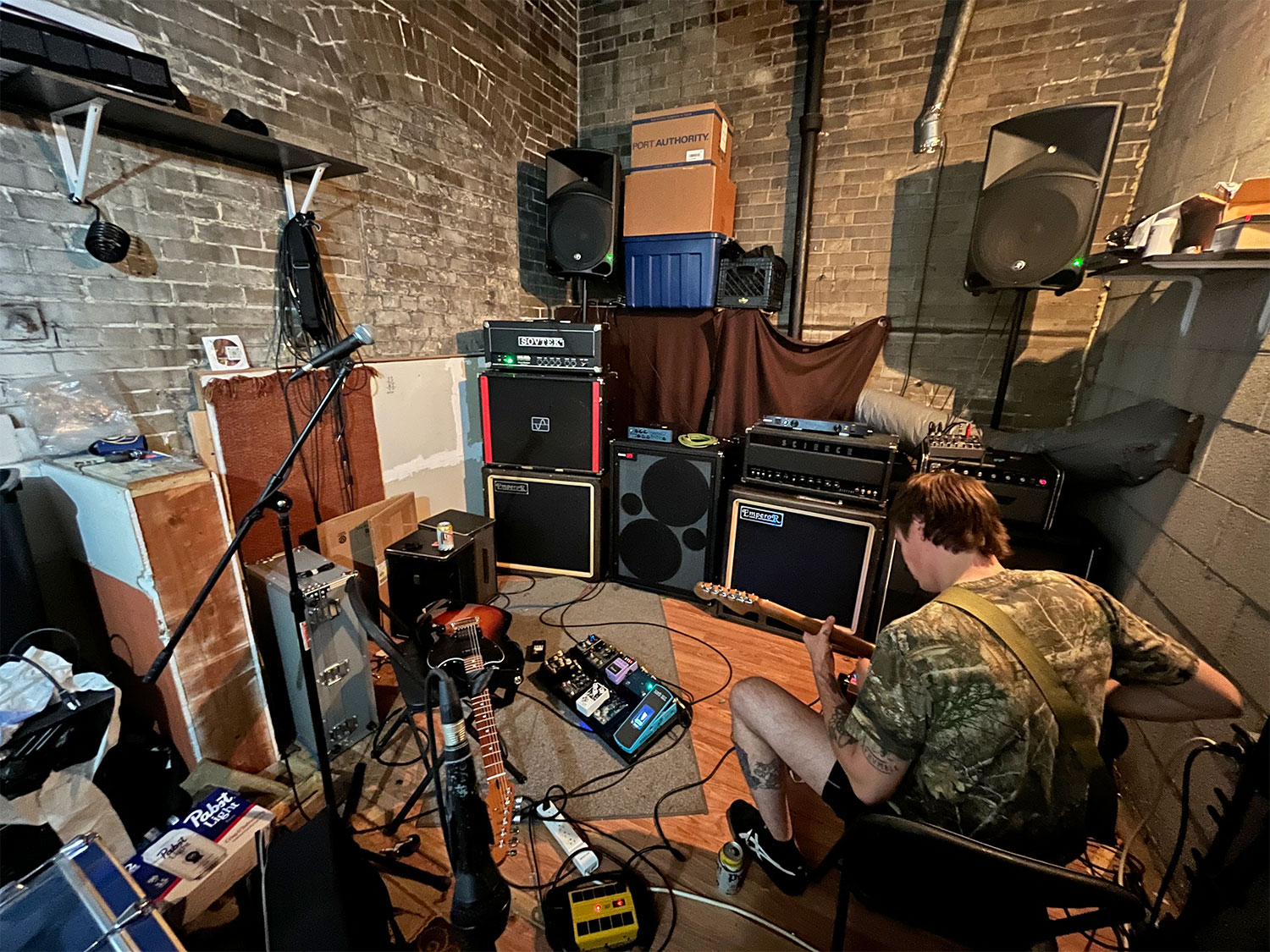
The first thing you do when entering the pitch black room is reach for the light switch. Even though sunset isn’t for another two hours or so, there isn’t a single window to the outside world, creating the illusion that time doesn’t exist here.
A wall of speaker cabinets and amplifiers stand guard on the opposite side of the room. A satisfying flip of a switch on one amp introduces the hum of working electronics to the room, the overhead light flickering for a moment as if the building is struggling to keep up with the power of the amp.
Next door, you hear your neighbors. You still can’t decide if they’re a shoegaze band or just an emo band. They’re working on the same song that you heard them jamming last week, but this time they seem to have figured out the bridge section they were workshopping. You’re excited for them to hear a muffled version of what you’ve been working on as well. You and your bandmates nod to each other, and you launch into your first song. Band practice has officially begun.
Okay, maybe I glamorized my band’s soon-to-be old practice space a bit much. But when you spend years in a tiny room with some of your best friends drinking beer and creating meaningful (at least to us) music, it becomes a magical space. And I’m sure that anyone else who has ever rented a practice space for their bands would agree.
That’s why it was heartbreaking to hear that The Ring, where my bands Garden Home and Okay Omen currently practice, is closing. The building, located at 515 S. 1st St. in Walker’s Point, houses dozens of bands in its 37 practice spaces. By July 31, it will be home to none. Building managers Kat and Paul Kneevers shared the unfortunate news that the owner has plans to tear down the building.
“It’s part of the renovation of the neighborhood—the building is unfortunately past its ‘sell by date,'” Paul says. “Kat and I kept this going for as long as we could. The Sanfelippo family (who owns the building) have been behind us the whole time and they’ve been as good as you can get.”
The Kneevers see this as an inevitable part of a changing neighborhood. As the price of utilities grows higher and higher, the overhead cost for running a large practice space that hosts dozens of musicians who are on a tight budget becomes increasingly difficult to meet.
While the Kneevers were very transparent about this move and gave the current tenants plenty of time to find a new space, myself and the other musicians renting at The Ring have quickly learned that there aren’t that many practice spaces left in Milwaukee.
Groups on social media, like the Riverwest Neighborhood page, began seeing posts asking for practice space recommendations to no avail.
“A majority of the places recommended were already at capacity,” says Max Niemann of Diet Lite and Max & The Fellow Travelers. “I’m in the unfortunate situation of having to find new space for not one, but two bands at the moment. At this point I’m starting to look for spaces outside of the city.”
Others who rent at The Ring have faced a similar dilemma.
“We had been at The Ring for close to ten years, and the reason we rented here is because there was a severe lack of any other spaces in town,” says Jason Ellis of Cryptual. “For years, trying to find a practice space around the city without having to ‘know someone’ has been really challenging.”
In a perfect world, Milwaukee would help fund spaces like this. But the reality is that this is highly unlikely—last year, the city had issues regarding cut funds to organizations like Milwaukee Ballet and the Milwaukee Repertory Theater. It’s hard to believe that the city would find ways to fund practice spaces for local bands with names like World I Hate to write music in.
This clearly isn’t a new issue in Milwaukee. An article published by the Shepherd Express in 2012 titled “Where Can a Band Even Practice Anymore?” feels like it could’ve been published today. So why is it so difficult to find a practice space in Milwaukee?
“Commercial real estate is still commanding premiums and many large commercial buildings are being repurposed or razed,” says Skott Moriarti, owner of Music Go Round Greenfield and Kenosha. “The Venn diagram of room rental rates to construction costs barely kisses as well.”
The city’s building occupancy codes also play a part. Many practice spaces are used by more than one band, and cramming a bunch of musicians and electronics into several old rooms rarely looks safe on paper, which is why a lot of practice spaces are only known by word of mouth.
“It’s the consequence of real estate going up, and we as musicians are going to have to get crafty,” Paul Kneevers says. “But I think that if anyone can find a way to do it, it’s musicians, because we’re some of the craftiest mofos out there.”
And Paul is right. Historically, musicians have had to get creative in order to find spaces to practice in. Bill Rouleau, co-owner of Rushmor Records, used to let bands practice in his basement. Decades ago, Jim Finn, an attorney by day and a keyboard player by night, owned the now defunct Cornerstone Recording in Walker’s Point and was known to allow bands to practice in the building in exchange for help maintaining it. The Borg Ward, which closed in 2016, was an art-gallery-turned-all-ages venue that was home to a handful of band rehearsal spaces.
But for 30-plus bands to happen upon unique circumstances like this in a few months time is pretty unlikely. Practice spaces, much like DIY venues, will come and go—they always have and probably always will. If the pattern continues, another spot like The Ring will pop up eventually. But what happens when that space too eventually closes?
The Kneevers still run practice spaces and a studio in a second building in Walker’s Point. The 36 practice rooms there are all full. Paul estimates that between the two buildings, around 350 people held keys to at least one of the spaces.
“I get three to four requests for practice spaces a week,” Paul says. “I could build a hundred more practice rooms and they’d be filled in weeks. It sucks that we can’t provide that.”
A few weeks ago, a study by Squarespace named Milwaukee the best city in America for creatives. The report mentions Milwaukee’s music scene as well its affordability for creatives. But without a space to be creative, how can our city’s musicians thrive the way that Squarespace leads its readers to believe that we are?
Cue Sarah McLachlan’s “Angel”
I honestly don’t know what the solution is. My hope is that this article can help the remaining displaced bands find new spots to rehearse in. Maybe you know of some commercial space that isn’t being used, or own a business that has some extra space that could be repurposed for weekend use. Maybe you’re in a band that already rents a practice space and you have room for one more.
Milwaukee doesn’t need another Live Nation venue. Milwaukee doesn’t need any more luxury apartments. Milwaukee doesn’t need more coworking spaces.
Milwaukee needs more practice spaces.
Want more Milwaukee Record? Subscribe to our free weekly newsletter and/or support us on Patreon.