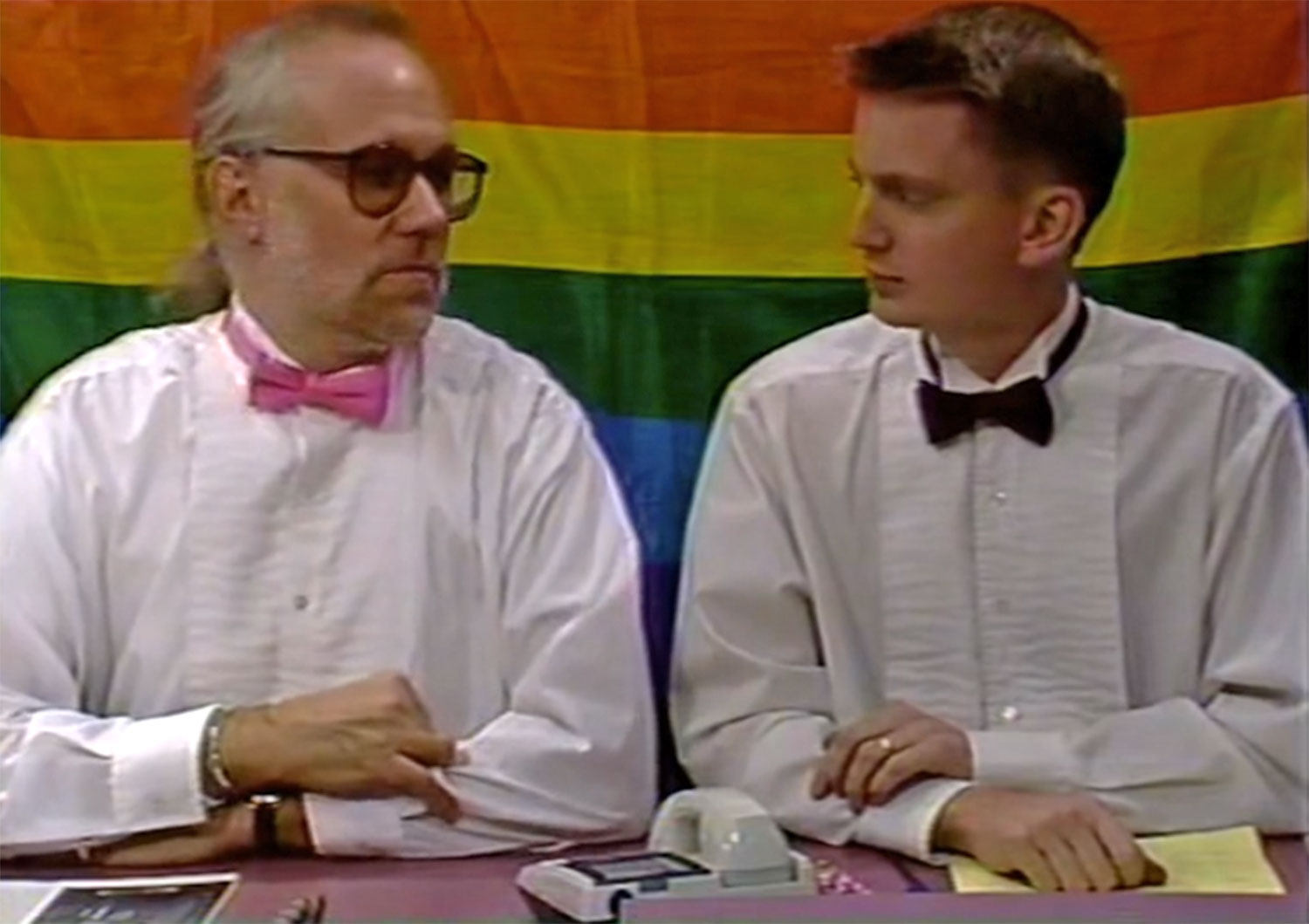
In anticipation of PrideFest Milwaukee (June 4-6), here’s a look back at groundbreaking LGBTQ+ public access television show The Queer Program (1992-2017). For more information on the history of LGBTQ+ television in Milwaukee, check out the UWM Archives. To learn more about The Queer Program, be sure to attend PrideFest on June 6, where there will be clips from The Queer Program, along with a Q&A with co-hosts Dan Fons and Michael Lisowski, at the Stonewall History Tent.
Dan Fons and Michael Lisowski were activists in Milwaukee’s gay community, and while they found camaraderie in groups like Queer Nation and ACT UP, they were frustrated that LGBTQ+ Milwaukeeans couldn’t readily and reliably see themselves represented in local media. Fons and Lisowski realized that LGBTQ+ people in Milwaukee were often isolated and had no easy access to support or safe places where folks could get together. In late ’80s and early ’90s Milwaukee, accessible information was limited to the phone book and that big square that served as the center for most American homes: the television.
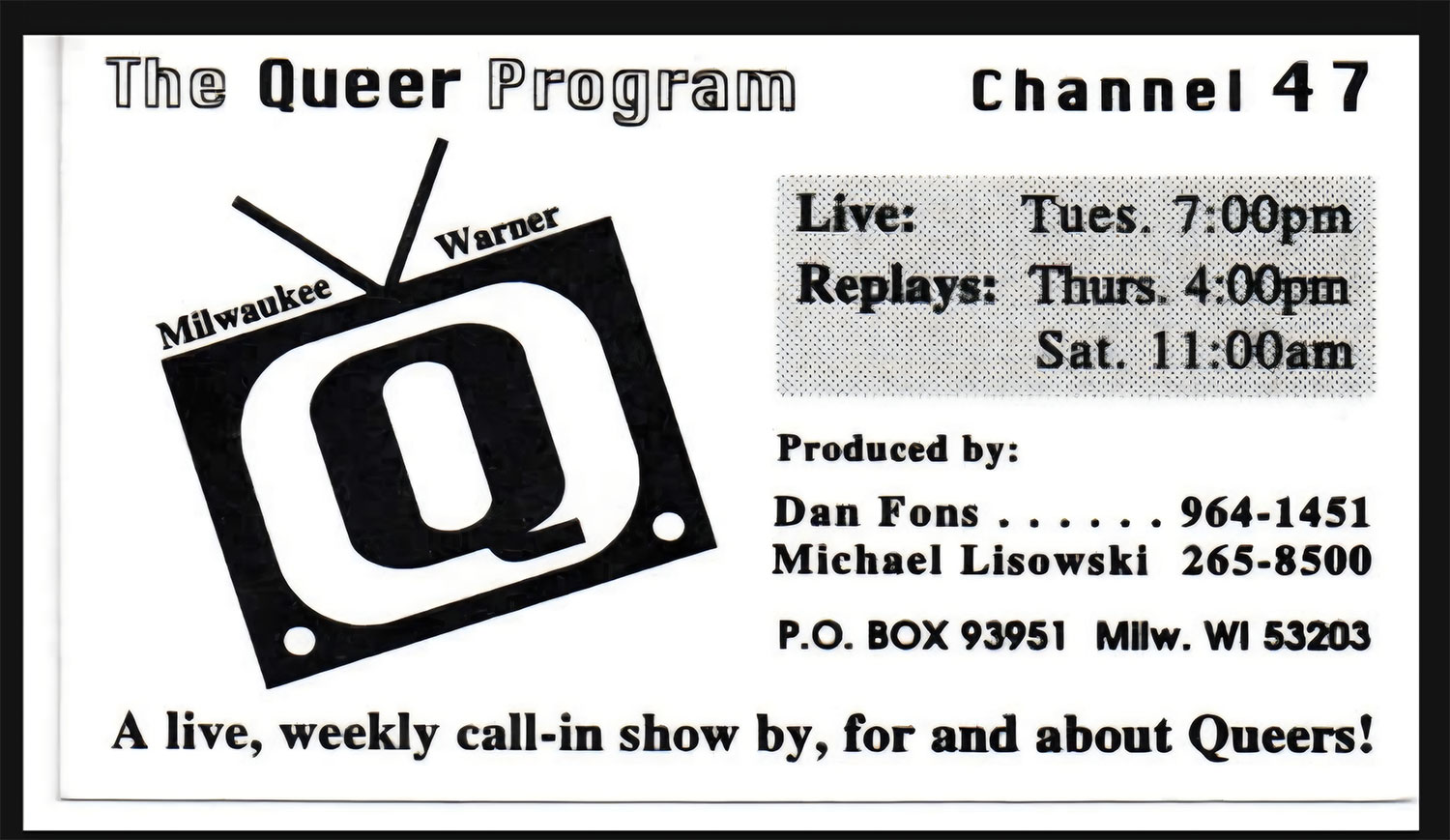
Here’s a brief summary of the origins of LGBTQ+ public access TV in Milwaukee from the UWM Archives of Milwaukee Gay/Lesbian Cable Network Records, 1987-1994:
The Milwaukee Gay/Lesbian Cable Network (MGLCN) was a volunteer group that produced regular and special programming on gay and lesbian issues for Milwaukee’s public access cable channel. MGLCN was aided by the Milwaukee Access Telecommunications Authority (MATA), a non-profit corporation created to provide citizens with access to Milwaukee’s cable system. MGLCN executive producers included Mark Behar and Bryce Clark…The [Tri-Cable Tonight] show was described as “cable television series exploring the color and diversity of Milwaukee’s Gay and Lesbian Community.” The first episode of Tri-Cable Tonight aired October 27, 1987.
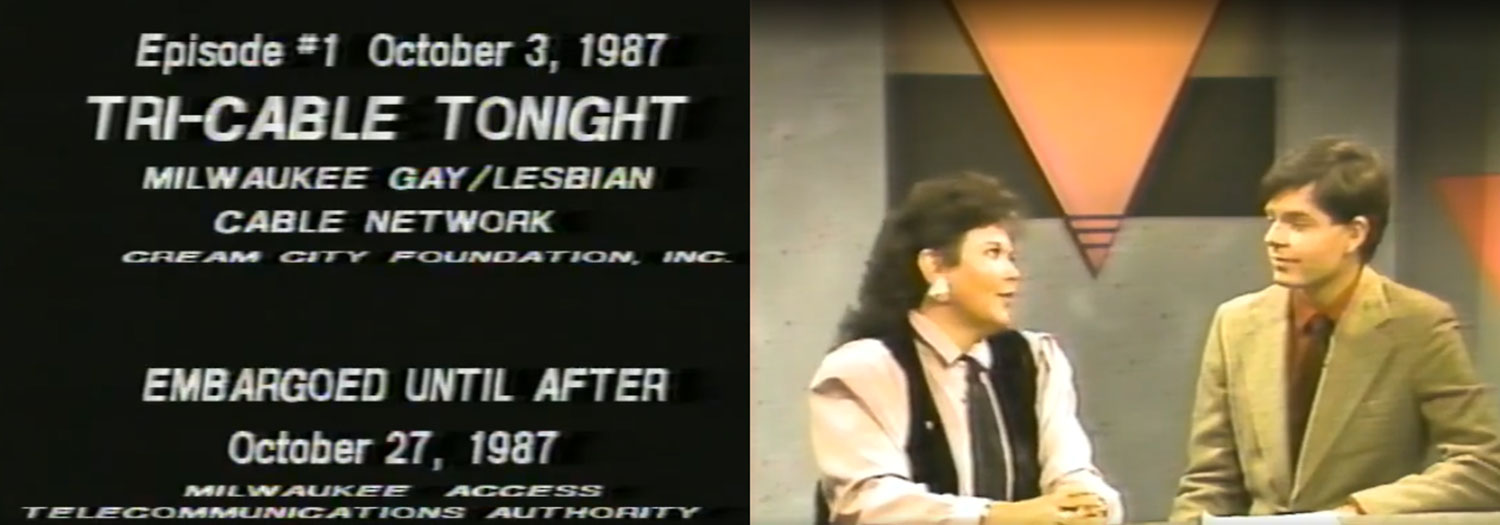
Inspired by the breakthrough public access television programs like Tri-Cable Tonight, Fons and Lisowski conceived of a new show that they would initially call The Brand New Queer Program. They hoped to provide a hub of information and community for LGBTQ+ Milwaukeeans and those who wanted to learn more and/or support LGBTQ+ progress during a time that saw laws like “Don’t Ask, Don’t Tell” and the Defense of Marriage Act dominating the local and national political landscapes. Landing on network television, or even PBS, was an impossibility for The Queer Program, but thanks to Lisowski’s connections, they found a home in prime time on Milwaukee public access television, channel 47, on a “live, weekly call-in show by, for and about Queers.”
I was fortunate to encounter Dan Fons recently, and he graciously shared his memories of co-hosting The Queer Program, which will be celebrated at PrideFest Milwaukee on Saturday, June 6, at 4:30 p.m.
Milwaukee Record: What was available on TV back in the early ’90s, for a queer audience?
Don Fons: It’s hard to imagine the pre-internet world now, but it involved a lot more fear and isolation. Certainly I didn’t see many images of gay characters on TV. Dynasty had a character named Steven who was gay once in a while, but then he wouldn’t be gay the next episode. All the movies about gay people were very formal, trying to be instructive. PBS had a show called In The Life, which they had to play at 11:30 at night. They couldn’t play it during prime time. Milwaukee was fortunate, though, beginning in the late ’80s, to have a local pre-recorded monthly public access show similar to In The Life, focused on the gay and lesbian community. That show was filmed in a more traditional studio style, and the people who put it together really broke the ice for The Queer Program.
MR: So The Queer Program was pretty groundbreaking, especially for Milwaukee.
DF: The Queer Program brought a new, live, weekly, interactive, unscripted, and activist prime time approach that could accomplish different things, but Milwaukee did have monthly, locally produced programming on gay topics. The reason we were called The Brand New Queer Program the first year was to differentiate ourselves immediately from the other regular show, I think called Tri-Cable Tonight, at the time. And the reason Michael learned early about the MPACT studio is because he used to be host/interviewer sometimes on those other shows.
The early years (1992-1996) were mostly pre-internet, so the weekly info sharing and accessibility of a queer, unscripted, interactive prime time show was probably the biggest contrast to what existed in people’s lives before then. In those years, you couldn’t really research anything from your home. If you wanted to explore you didn’t even know if there was a community of gay people out there. You couldn’t just look it up. AIDS was really at its peak…it was a death sentence, if you were diagnosed it was expected you’d be dead in two years. It was very hard to get information. You could not just find out about stuff from home and interact with gay people from home. In Milwaukee, our show was sort of a game-changer during those years.
MR: How did the show come together?
DF: In the mid-’80s, Congress said that cities negotiating contracts with cable TV companies (and giving them a market monopoly over what gets to people on cable TV) could require a cable company to provide public access studios where anyone could create and air a TV show.
MR: Did you have to pitch the idea or get a green light to start the show?
DF: There was no pitch involved. Michael had experience at MATA (Milwaukee Access Telecommunications Authority). He learned they created this little studio, called MPACT, specifically designed so a single person could put a show on TV. Back then, access to sending video to people’s homes was only through your TV. There was no other way to send video without a TV set, so Warner had tight control over that. The cable company was not allowed to regulate the viewpoint or content of what was produced in those studios (beyond legal limits like obscenity, etc.). That’s why we didn’t need an okay from MATA to start our show. We just needed to fill out paperwork and go through simple training.
MR: What was the technology like for a public access TV show in the early 1990s?
DF: They [MATA] deserve a lot of credit for creating that studio. It was so simple a monkey could operate it. There were three buttons on the desk in front of us: one for the camera looking at us, the second was the camera looking down at the desk where we showed printed items, and the third button was to show anything I could put on VHS tape. It made it possible for one person to broadcast a show solo if they wanted to, and that made it possible for us to easily throw together and broadcast a show each week. Our show was the first regular show in the MPACT studio. It could reach a lot of people right in their homes at 7 p.m.
MR: So when did The Queer Program first air in Milwaukee?
DF: We did the first two shows in November of 1992, right after Clinton was elected. Once we did those we were guaranteed a time every week. The schedule was open so we picked 7 p.m. prime time on a Tuesday. In order to be on prime time you did have to have a sponsor of a non-profit. We knew Gay People’s Union and they let us use their non-profit status as a way of getting on in prime time. Michael was part of that group. We both kind of showed up and put the [rainbow] flag behind us, which became our standard background. It was kind of loose, we just showed up and started doing it. We always knew we could go to calls. People loved the calls. It was not scripted.
MR: For people who stumbled upon The Queer Program, it must have been a revelation.
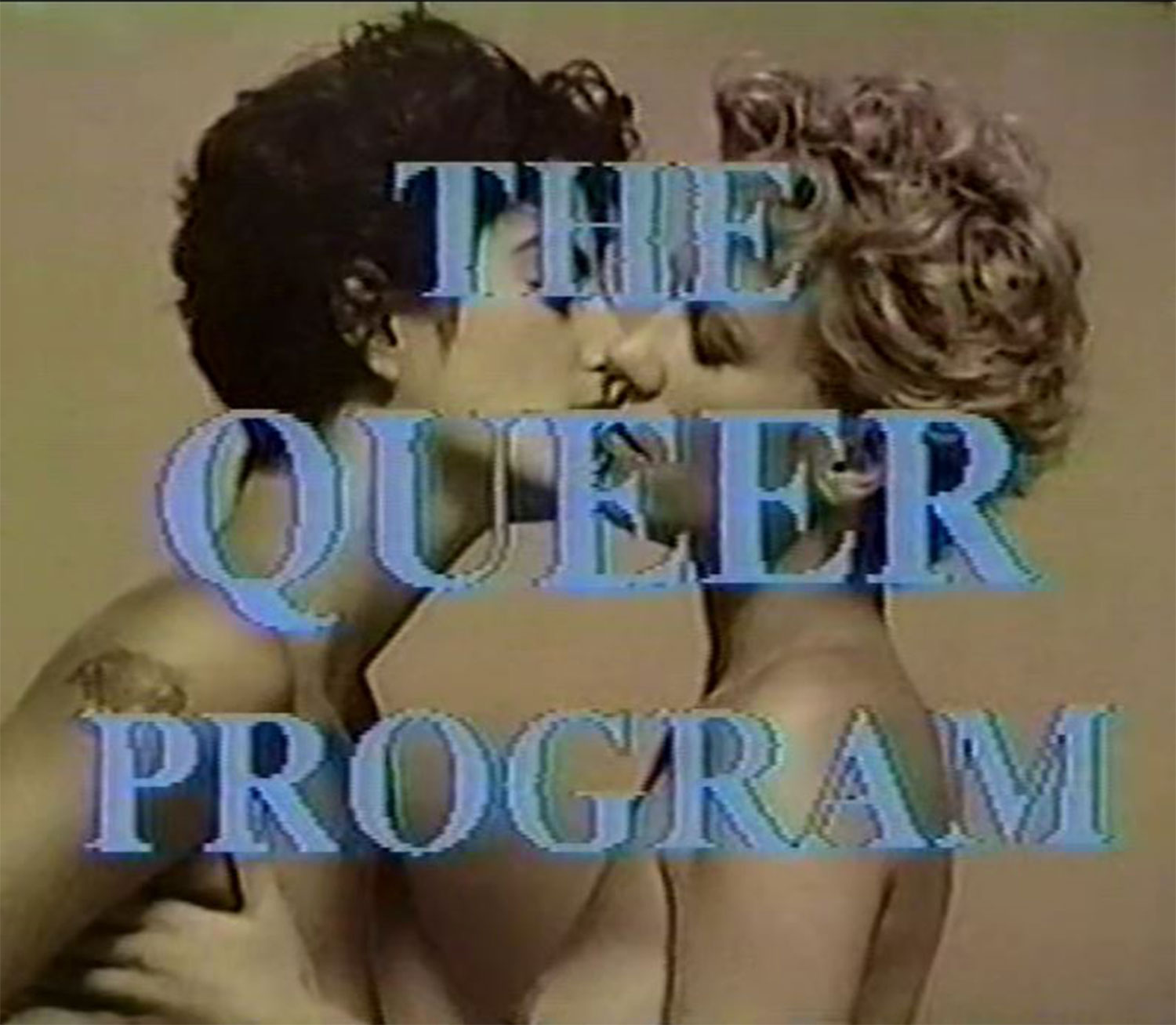
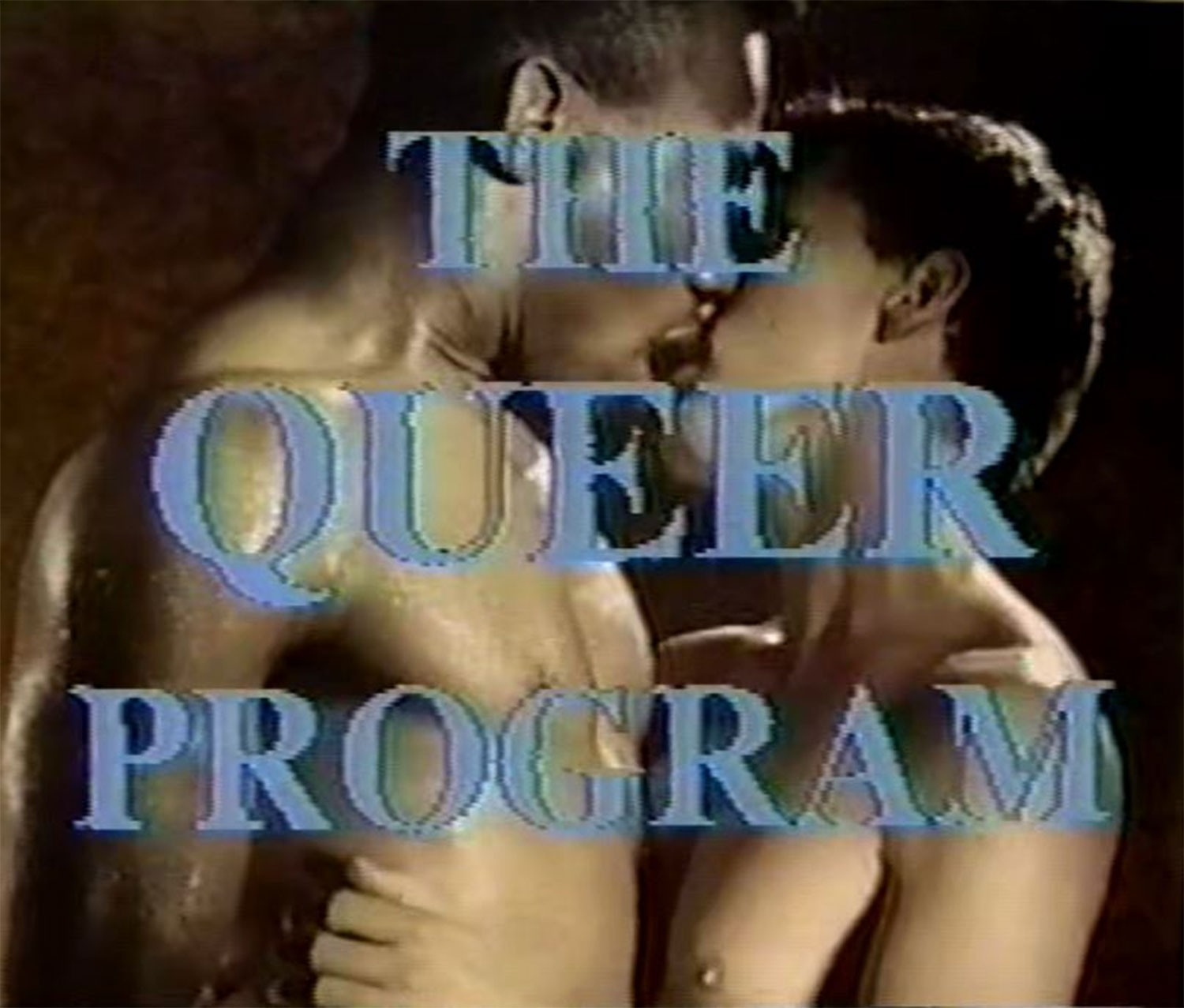
DF: I always pictured some teenager, just going through the channels, and all of a sudden they see this thing come on and it’s The Queer Program. Immediately in the opening there’s same-sex people kissing, the words “cock sucker” right on the screen, there’s Harvey Milk…I always kind of liked the idea that suddenly there’s the whole world exploding of possibility. The show was there for people to watch and learn, feel part of the community. We were very different. It was weekly, interactive, very down to earth. Just talking to people, not trying to be news people. This was still a time when queer teens becoming aware of their feelings often wondered whether there was anyone else like them, so having a show they could stumble on and see a full community of people was important to us. We scheduled our replay times to be at times when teens were more likely to be controlling what channel their home TV was on.
MR: I like the way you would reply to unhinged callers. You were clinical, but in a good way. The Queer Program was so real, unpretentious, and informative. And you had great courage to take the calls from people live on air, especially as you knew some would be hostile.
DF: All calls were unscreened, no caller ID. I wasn’t interested at all [in caller ID]. Because we would get calls from youth, sometimes calling for the first time about being gay. And they never would’ve called that number if they had to go through screening.
MR: The way you handled those calls with such quick recovery was laudable.
DF: It was an experience. Really, we didn’t even think about the bad calls, we forgot about them the minute they were over, but people at home really noticed them. I like to think that we showed people how to respond to that kind of idiocy. We got a lot of terrible calls, people saying things to us. They say those things because in high school it would be devastating, it would ruin someone’s life. All they had to do was shout “faggot,” all they had to do was shout “cocksucker,” and that was the end of the argument. They’d call and say that to us, and we’d go “Yeah?” And we’d still want to talk to them but they would just hang up. I think it was a good way to show you could respond to that stuff in a different way. We would talk to them even if they completely disagreed with us and thought being gay was wrong. We didn’t hang up on them because they disagreed with us. We did talk to everybody. I was from ACT UP and Queer Nation, so I was bringing an activist bent, trying to push harder not only for people to be okay with themselves but to be angry about their situation and to fight for full rights.
MR: You got the caller asking “How did you tell your parents you were gay?”
DF: The caller was laughing when they said it, but we treated it like a real question because we knew many people were listening so we would explain it anyway.
MR: Was it difficult to keep your cool, with the blazing ignorance engulfing you in flames during those times?
DF: No. I get enraged at people being oppressed and discriminated against. Do you mean like the people calling and saying negative stuff?
MR: Yeah.
DF: No, we generally took it. We didn’t absorb their bad energy. We stayed above that. We got death threats. Queer Nation was my home phone number. It was very common to get death threats, physical threats, at home and on the show. We just didn’t treat them seriously. I just think it’s better to handle them the way we did.
MR: Tell us about your co-host, Michael Lisowski.
DF: In those days, there was really one person in Milwaukee who was welcoming young people, who wanted to stick their head out of the closet, and that was Michael. He ran Gay Youth Milwaukee, the number went to his home phone. He ran the group, he welcomed everybody with open arms. He ran speakers bureaus with kids, who could speak at high schools and talk to students about being gay to build up confidence and help them socialize. He was really it. My brother who came out, he went to Michael’s group early on, almost everybody passed through that group. I think all there ever was before The Queer Program being so accessible was Michael’s group, Gay Youth Milwaukee. It was hard…the only way was to look in the phone book and be brave enough to call the number.
MR: I thought this would’ve blown some minds back then: you calling U.S. Senator Herb Kohl on live TV saying, “We know you’re gay, why are you voting against your own interest?”
DF: To say it blew people’s minds is an understatement. Yes it did.
MR: Tell us about that.
DF: I’m sure I brought that to the show from my Queer Nation and ACT UP stuff. At the time the word “outing” was applied to that sort of thing, which was kind of a negative term. At that time if you wanted to say someone was gay in public you had to have almost a written affidavit from them swearing that they are and that it’s okay to say in public. No one ever did it. But we wanted people to live in a world where you could say it. It should just be like an eye color, right? Your eyes are blue; you’re gay. You should be able to say it, you should be able to observe it.
We knew some people in Wisconsin politics who were gay, not just Senator Kohl. These people are in public life, we should be able to talk about the fact that they are gay. And the other reason to talk about it is if someone is clearly acting against the gay community and they are in the closet, it just adds an extra reason to feel free to say that they are gay.
With Senator Kohl, he did consistently make votes that were against the gay community. He voted for “Don’t Ask, Don’t Tell,” he voted for a Jessie Helms amendment that would’ve taken federal funding away from all schools that supported queer kids, even if they just offered them counseling for suicide. So he got our attention in a special way, because not only was he in the closet and very powerful—there was no reason he needed to be in the closet—but he was doing these votes against our community. The community was not comfortable with us doing that at all, it was not something that was happening. At the time, I was thinking that we were sort of five years ahead of that curve, but I think it was more like 15 years later until you could talk about who was gay without people freaking out.
I would have that conversation with news people. We did a protest against Senator Kohl when he voted for the Defense of Marriage Act which banned gay marriage. We had a protest…we got other people to go out in public and say this guy needs to come out, with signs marching in front of the federal plaza. The press was struggling with this. They all covered [the protest] but they didn’t want to mention the fact that we were saying [Senator Kohl] was gay. That made them very uncomfortable. It was a moment to try to teach people: alright, we’re gonna have to get past this sometime, we’re gonna have to start talking about who’s gay. Some people saw outing as a violent act, but we saw it more as this should be okay, we want to get to a world where it is okay and we’re going to start doing it. But a lot of people were uncomfortable about it.
MR: Was there concern about retaliation?
DF: No, we weren’t concerned. But perhaps we should’ve been. He would’ve been drawing more attention to himself. There’s this infamous cover of the Shepherd Express that has Herb Kohl’s picture on it in a pink triangle that says “Herb Kohl has a Queer Problem.” That caused a big controversy, that was right after our protests. Obviously it was kind of brash. If you’re concerned about that kind of thing, you’re not going to keep going.
MR: Related to Senator Kohl, you mention “closet of power.” That was a term I was not familiar with.
DF: He was in his closet of power, in a very powerful position, one of one hundred people in the U.S. Senate, the richest senator at that time. He had nothing to lose, he could have done anything he wanted. When he announced he was going to resign, I wrote a letter to his office saying, “Now you can come out.” He had nothing to fear compared to people who come out in different situations, he could come out and be a hero. But he never did.
MR: Your sign-off line for The Queer Program was absolutely perfect.
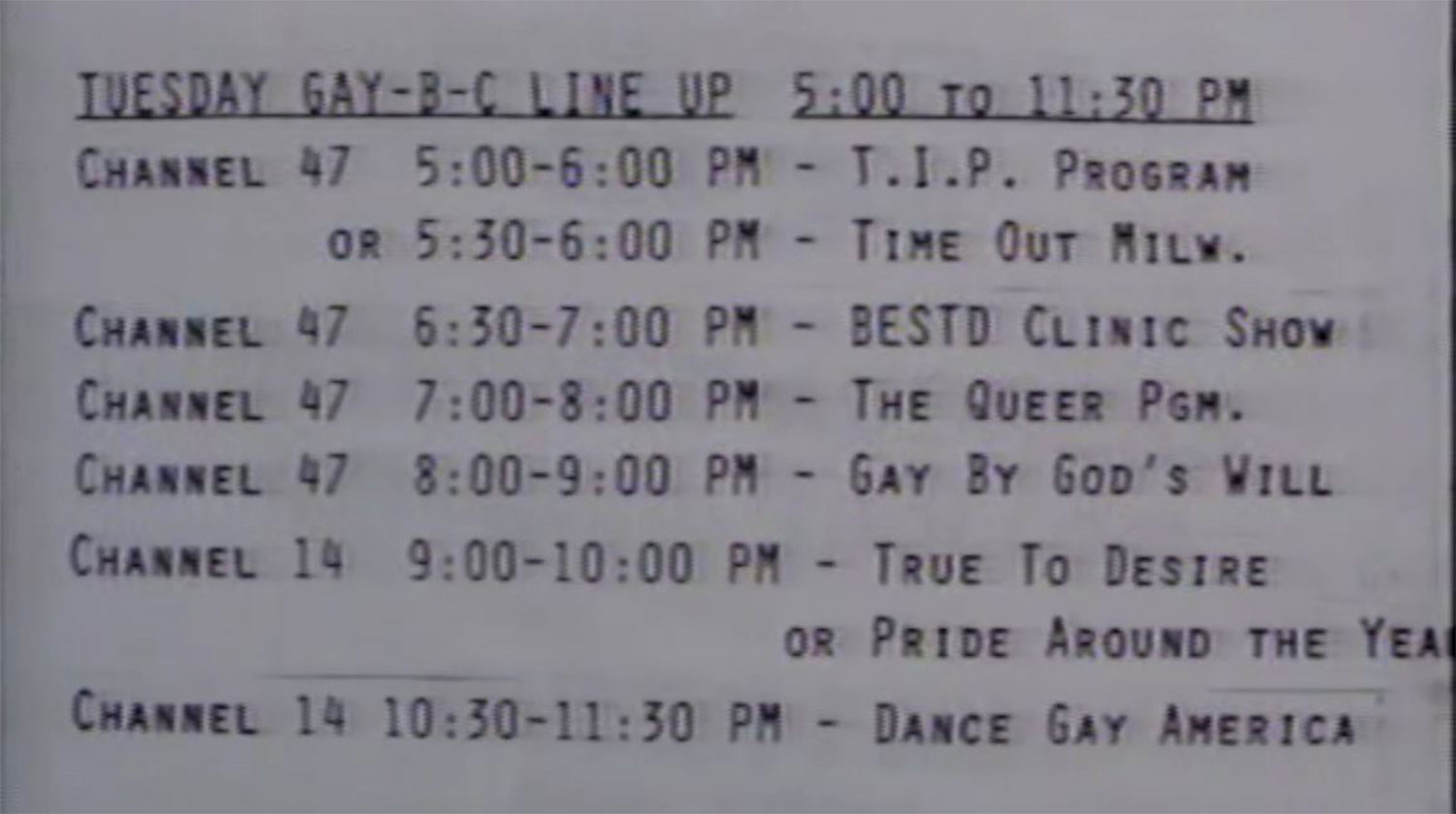
DF: “Be as queer as you want to be” was the sign-off line. We liked to say that the show was “by, for, and about Queers.” There was no “straight filter” applied. We were talking to each other, and other folks were welcome to watch and join in with us, too. That’s something that was very different from most other limited presentations of queer people and content on TV or in movies. Then, in the following years, other queer-related shows started and scheduled their replay times to be around our live show. Also, Brandon Marsh Entertainment—some producers at MATA—developed further pre-recorded queer related shows like Dance Gay America and a local gay soap opera, and they scheduled those around us. So we ended up having an entire evening of queer shows every Tuesday night, and we dubbed that GayBC.
I co-hosted The Queer Program for its first four years, before moving to San Francisco. The show continued with other co-hosts over the years, but the video record of the show seems to just include the years I was on, because I had VHS tapes of the shows.
MR: Speaking of the VHS archives, tell us about the upcoming PrideFest event.
DF: The UWM LGBT Archives is leading an event at the Stonewall History Tent area of PrideFest this year where they will play a ten-minute compilation of clips from The Queer Program, do some interviewing of me and Michael Lisowski, and then take questions from attendees. This PrideFest event is scheduled for Saturday, June 6 at 4:30 p.m. I do want to encourage people to attend the June 6 event at PrideFest. If people used to watch, we’d love to have them come say hi, share memories, and participate. If people have never heard of the show or public access TV before, we invite them to what we hope is a fun look at some Milwaukee queer history. If they want to see full episodes of The Queer Program, they can visit the UWM Archives, Milwaukee Gay/Lesbian Cable Network Records, 1987-1994.
Want more Milwaukee Record? Subscribe to our free weekly newsletter and/or support us on Patreon.